
Sous Vide Guide & Calculator

Times & temperatures by cut, thickness, and doneness—with HACCP logging.

Set your bath once, then let time and thickness do the work. Pick a protein and cut, enter thickness, choose doneness (where applicable), and we’ll estimate a practical cook window. Always finish with a quick hot sear for color and flavor.

Estimates assume properly sealed bags, typical starting temps from fridge, and a well-regulated sous vide bath.
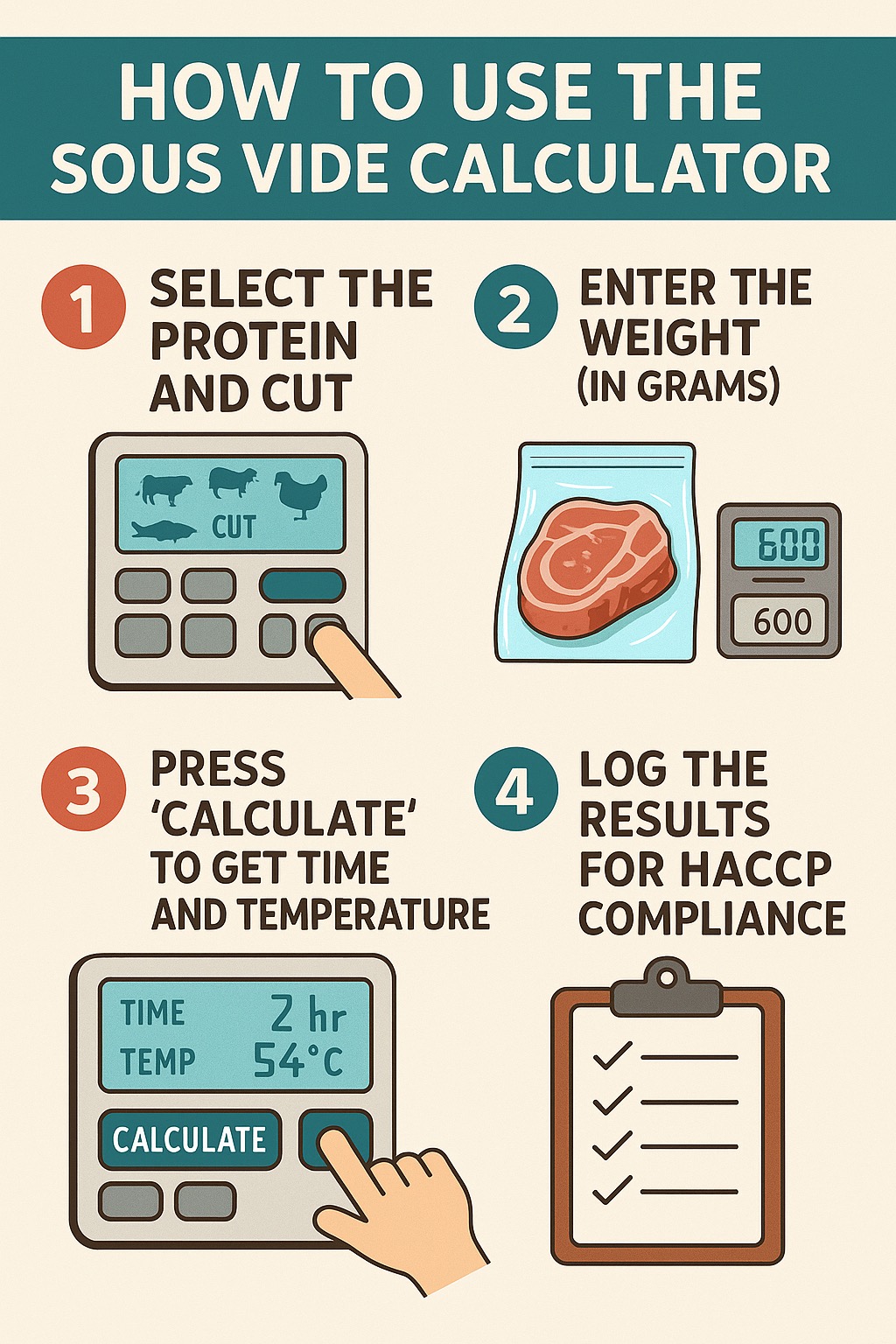
Sous Vide Step-by-Step Guide

Thickness Calculator

Measure the thickest point.
For HACCP log only—time is driven by thickness.

Safety: USDA recommends poultry 165°F (74°C) and ground meats 160°F (71°C). Lower-temperature sous vide requires sufficient hold time for pasteurization. When in doubt, choose higher temps.
Download USDA Safety PDF

📋 HACCP Monitoring Log

Protein Cut / Species Thickness (cm) Weight (g) Bath Temp Cook Time Date Operator Signature
...
📄 Download Sous-Vide Bag Safety SOP (PDF) 📋 Download Sous-Vide Chef Safety Checklist (PDF)

From Frozen?

Add ~30 min for steaks/chops and ~60 minutes for roasts/large pieces. Break apart pieces in the bag so water can circulate.

Bagging & Searing

Season lightly, add a little fat if lean. After bath, pat completely dry and sear briefly in a very hot pan for color.

⚠️ STOP! Are You Using the Wrong Vacuum Bags?

Managing vacuum bags is not just about “sealing,” but about regulatory compliance and chemical and microbiological safety.

🧊 Bags for Storage (❌ NOT for Cooking)

Engineered exclusively to maximize shelf life at low temperatures (refrigeration). Usually multi-layer laminates or co-extrusions with polyamide (PA) for mechanical resistance and gas barrier, and polyethylene for sealing and moisture barrier.

These polymers are NOT thermostable. Cooking temperatures can degrade the plastic matrix and accelerate migration of untested monomers and additives into food.

🔥 Bags for Cooking (✅ Sous-Vide Approved)

Technologically advanced materials designed to guarantee chemical inertness under prolonged thermal stress. They must comply with overall migration limits at the specific temperatures and times of the process (pasteurization/sterilization).

  • For hams/charcuterie: inner layer can bind to proteins to prevent gelatin/fat separation and improve yield.
  • Seal integrity even in the presence of fats/liquids during hot packaging.

❄️ Bags for Freezing (Blue Bags)

Not every bag is suitable for blast freezing or freezer storage. Non-specific bags can micro-crack with minor mechanical stress. Ice crystals can be sharp and create cuts under pressure.

Use bags with adequate thickness and reinforced blends to resist cuts, maintain barrier properties, prevent freezer burn, dehydration, and oxidation of fats.

Vacum seal bags

Use the right for your specify production usage.

Sous vide vacuum bag guide: storage vs cooking vs freezing
🚨 WARNING: Anaerobic Environment Changes the Risk Profile
Vacuum creates an anaerobic atmosphere. Aerobic flora (that normally signals spoilage) is inhibited, which can mask the proliferation of anaerobic or facultative pathogens such as Clostridium botulinum, Clostridium perfringens, or Listeria monocytogenes.

Imperative controls:
  • Validated thermal cycles
  • Rapid cooling protocols
  • Strict cold-chain maintenance for non-sterilized products